


For a growing number of expectant mothers, access to maternity care depends heavily on where they live.
The March of Dimes’ 2026 report, Nowhere to Go: Maternity Care Deserts Across the U.S., found that more than one-third of U.S. counties (34.6%) have no obstetric clinicians or birthing facilities. The divide is especially pronounced in rural America, where nearly 58% of counties lack an obstetric clinician, compared with approximately 19% of urban counties.
Meanwhile, labor and delivery services continue to disappear. At least 96 hospital labor and delivery units closed across 35 states between 2024 and early 2026. In nearly 60% of the affected counties, the facility that closed was the community’s only local option for giving birth.
The resulting maternity care deserts are not merely dots on a map. They represent mothers traveling farther for prenatal appointments, delaying care because transportation or time away from work is difficult, and navigating pregnancy without reliable access to specialists. Residents of maternity care deserts travel approximately three times longer, on average, to reach labor and delivery services than those in full-access counties.
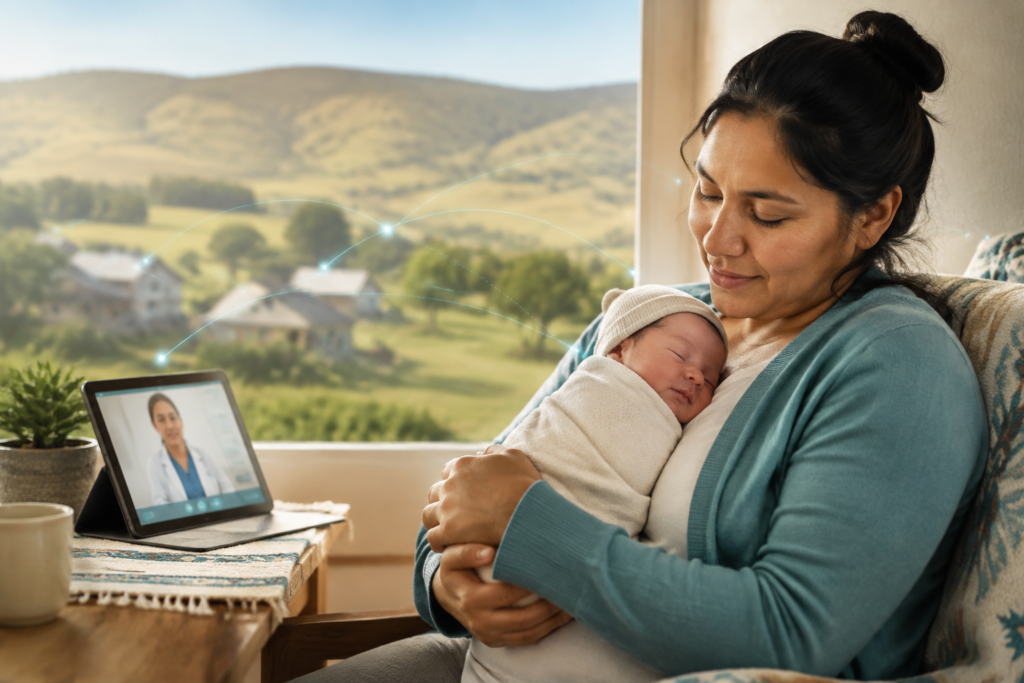
For rural hospitals, the problem is equally complex. Maintaining local maternity services requires scarce clinical talent, sustainable patient volumes, and around-the-clock readiness. When even one clinician leaves or a service line closes, the effects can ripple across an entire region.
A Timely Opportunity to Reimagine Access
The CMS Innovation Center’s Transforming Maternal Health (TMaH) Model offers a framework for addressing some of these challenges.
TMaH is a 10-year, state-based model focused on improving Medicaid and CHIP maternal health outcomes through whole-person care, stronger coordination, and more sustainable payment approaches. Fifteen participating state Medicaid agencies are working with managed care organizations, hospitals, rural health clinics, maternity providers, community organizations, and other partners to implement the model.
The program emphasizes several areas that are particularly relevant to rural communities:
- Expanding access to maternal health providers, including midwives and doulas
- Improving management of conditions such as hypertension and gestational diabetes
- Integrating behavioral health, substance-use, and social-needs support
- Strengthening postpartum care
- Supporting telehealth and regional rural partnerships
- Building the data and clinical infrastructure needed to measure and improve maternal health outcomes
TMaH is distinct from the broader Rural Health Transformation Program (RHTP), but the two share an important premise: lasting improvement will require new care-delivery models, not simply asking an already strained rural workforce to do more.
Extending Expertise Without Requiring It Everywhere
Virtual care can’t replace local obstetric services or eliminate the need for safe places to give birth. It can, however, help health systems distribute limited expertise more effectively and surround rural clinicians and patients with support that would otherwise be hours away.
Fractional shared service models can help here. A regional maternal health network might connect an academic medical center, maternal-fetal medicine practice, or health system hub with rural hospitals, critical access hospitals, clinics, and community-based providers. Through that network, virtual care could support:
High-risk pregnancy consultation. Rural clinicians can bring maternal-fetal medicine and other specialists into prenatal visits without requiring every patient to make a multi-hour trip.
Remote monitoring and earlier intervention. Connected blood-pressure monitoring, diabetes management, and virtual check-ins can help care teams identify concerning changes between appointments and escalate care sooner.
Labor and delivery support. When specialty expertise is not available onsite, virtual consultation can help local teams evaluate risk, coordinate transfers, and manage time-sensitive situations.
Postpartum continuity. Virtual follow-up can make it easier to assess recovery, reinforce education, monitor hypertension, support lactation, and identify warning signs after a mother returns home.
Behavioral health and social support. Remote behavioral health clinicians, social workers, interpreters, and care navigators can help address needs that directly influence maternal outcomes but may be difficult to staff locally.
Workforce reinforcement. Virtual nurses and other remote team members can assist with patient education, documentation, discharge preparation, and safety checks, allowing onsite clinicians to focus on hands-on care.
The goal is not to recreate a tertiary maternity center in every rural community. It is to make the expertise of that center accessible wherever the patient and local care team happen to be. This offers rural health organizations a sustainable fractional service model that helps close maternal health gaps without there being an onus on rural providers to directly staff the department full time.
From Temporary Funding to Durable Capacity
The TMaH payment model creates a progression from infrastructure development to quality incentives and ultimately, value-based care. Participating states can use early funding to support care transformation and data infrastructure, followed by incentives tied to measures such as timely prenatal and postpartum care, depression screening and follow-up, Cesarean delivery rates, and severe obstetric complications.
That progression matters. Technology investments should not be viewed as isolated projects that disappear when grant funding ends. They should become part of a sustainable regional care model that expands access, supports the workforce, and generates measurable improvements over time.
Virtual care helps healthcare organizations build the infrastructure to connect patients, local care teams, and remote specialists across the health continuum. Hybrid care programs that weave virtual and in-person visits can support maternal health from prenatal consultation and monitoring through inpatient care and postpartum follow-up. This also establishes a foundation for health systems to extend remote or virtual workflows to other rural care priorities.
No mother should have fewer options simply because of her ZIP code. By combining local relationships with regional expertise and virtual connectivity, states and healthcare organizations have an opportunity to replace distance with access and build a stronger maternal health safety net for rural communities.
