


There are healthcare conferences, and then there is Epic UGM.
Every August, thousands of Epic users descend on Verona, Wisconsin, where the company hosts its annual User Group Meeting (UGM) at its notoriously whimsical and theme park-like campus. This year’s “Meet Me at the Midway” theme delivered the expected spectacle, but beneath the lighthearted carnival atmosphere was a more consequential story: Epic’s ambitions continue to expand, and the adjacent health IT ecosystem is evolving with them.
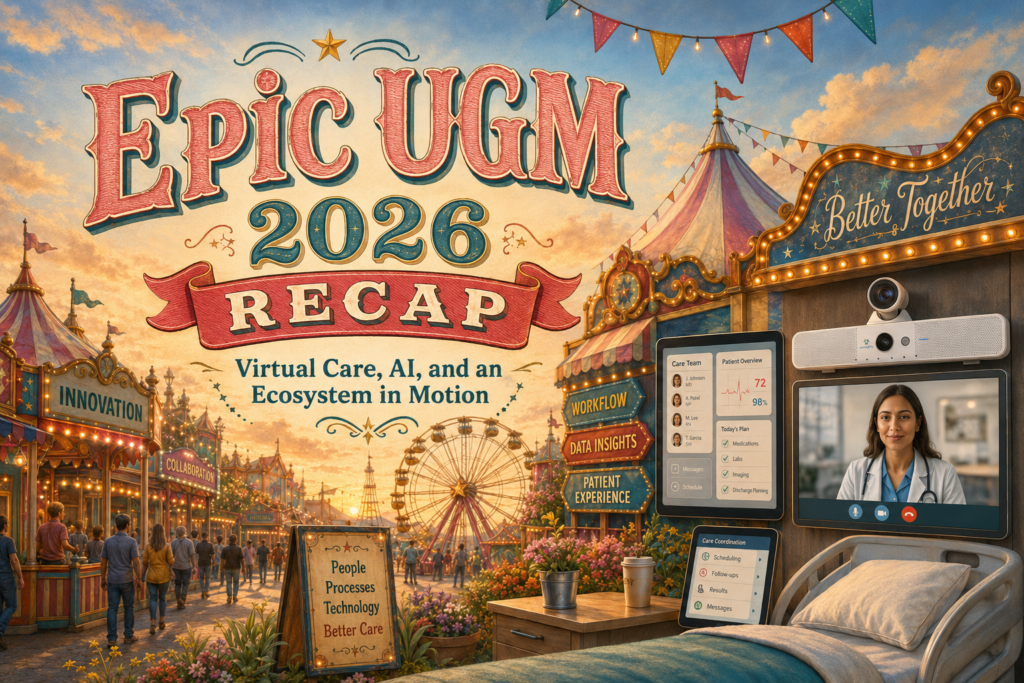
Epic unveiled or expanded a long list of capabilities spanning AI, patient engagement, revenue cycle, operations, clinical research, and more. Highlights included Ergo, a new intelligence-driven clinician interface; expanded capabilities for Art, Epic’s clinical AI; Agent Factory; Cosmos Curiosity; Intelligent Exam Room concepts; and continued expansion of MyChart and MyChart Bedside.
Collectively, the announcements raise a growing question for healthcare organizations and technology partners alike: as Epic’s platform expands, what belongs inside Epic, and where does specialized technology continue to add value?
Digital Workflows Move from Experiment to Operating Model
In the realm of inpatient virtual care, health systems are already demonstrating what they are achieving.
Caregility customers Salem Health and Johns Hopkins Medicine both presented sessions at UGM, highlighting their connected care programs. Salem detailed the evolution of a 60-bed virtual nursing pilot into a 340-bed program. Its original implementation deliberately centered workflows within Epic, including the Virtual Care Workspace, video calls in Epic, remote dual sign, MyChart Bedside, and third-party integration.
Their results were significant. In FY26, Salem reported virtual nurse participation in more than 95% of nearly 20,000 discharges, a 1.25% reduction in length of stay representing more than 3,500 hospital days saved, improved patient satisfaction around discharge information, and a net $1 million reduction in labor costs.
Real-world evidence is mounting on the benefits of treating technology adoption, workflow redesign, and clinical operations as one initiative rather than separate projects.
Bringing More Intelligence to the Bedside
The convergence of workflow and technology shaped Caregility’s presence at UGM. 2026 marks Caregility’s second consecutive year in Epic Toolbox for Inpatient Virtual Care. Caregility demonstrated how virtual nursing, observation, bedside engagement, and AI-assisted workflows can connect with Epic through CAL, eCAL, Epic Monitor, MyChart Bedside, Haiku, Hyperspace, and other Epic applications.
And the benefits are moving well beyond video. Caregility demonstrated how smart-room technology can connect remote clinicians with the bedside while capturing visual, audio, and sensor-based information that can increasingly support AI-assisted workflows.
Caregility’s APS200 Duo was incorporated into Epic’s own live on-campus demonstrations this year, a particularly meaningful milestone as the company returned to Toolbox for a second year. Along our journey with Epic, we’ve found that in an Epic-first environment, complementary technology increasingly needs to do two things simultaneously – deliver something meaningfully differentiated at the point of care and make that capability feel native to the clinician’s existing workflow.
Through the Grapevine: The Conversations Beyond the Keynote
Not every noteworthy UGM topic appeared on a keynote slide.
Recent leadership departures, including President Sumit Rana and AI leader Seth Hain, generated considerable industry discussion in the weeks leading up to the conference. Epic has said several longtime leaders are assuming expanded responsibilities following Rana’s departure, and Seth Howard notably led this year’s “Cool Stuff Ahead” presentation.
The timing naturally invites questions about Epic’s next chapter, particularly as AI becomes more central to its product strategy.
There is also a larger industry conversation underway about Epic’s growing reach. The FTC is reportedly examining aspects of Epic’s business practices, including how third parties access data, while Epic continues to contest antitrust allegations. Those matters remain allegations and ongoing proceedings—not conclusions—but their emergence underscores how consequential Epic has become to the broader health technology market.
Against that backdrop, products such as Art, Agent Factory, Epic Ops, native payments, integrated faxing, and Intelligent Exam Room naturally have technology vendors asking where Epic’s borders will ultimately stop.
Perhaps that is the wrong question.
Healthcare organizations are unlikely to choose between “Epic” and “innovation.” They will expect innovation through, around, and alongside Epic, with interoperability determining how seamlessly those pieces come together.
The View from Verona
One subtle reminder of that dynamic was visible simply by looking around UGM. The technology ecosystem represented alongside Epic changes from year to year. Remaining relevant requires more than building an integration once; it requires continuing to invest as Epic workflows, customer expectations, and care models evolve.
For Caregility, a second year in Epic Toolbox and inclusion of the Duo within Epic’s live demonstrations made UGM 2026 particularly meaningful.
But the more interesting story is where the market goes from here.
As Epic becomes more intelligent, expansive, and deeply embedded in healthcare operations, successful technology partners will need to become more differentiated and more interoperable at the same time.
And judging by what we saw in Verona, that next phase is already underway.
Explore Caregility’s Epic-integrated inpatient virtual care capabilities.
Additional Insights from UGM:
- Epic’s roadmap: 12 takeaways from Judy Faulkner (Becker’s Healthcare)
- Epic UGM 2026 – Judy Faulkner Keynote and Cool Stuff Ahead (Healthcare IT Today)
- HISTalk News (8/19/26)
- UGM Hot Takes 2026 (Brendan Keeler / Health API Guy)
