


Prepare your teams, workflows, and organization for sustainable virtual care adoption.
Virtual nursing, remote patient observation, tele-ICU, virtual consults, and AI-assisted clinical workflows are reshaping how care teams collaborate across the hospital enterprise. But successful virtual care implementation depends on more than selecting the right technology.
It requires intentional change management.
Health systems that see the greatest impact from virtual care are those that prepare their people, processes, and operating models before go-live. That means aligning stakeholders, defining bedside and virtual team roles, mapping workflows, training staff, addressing adoption barriers, and establishing clear measures of success.
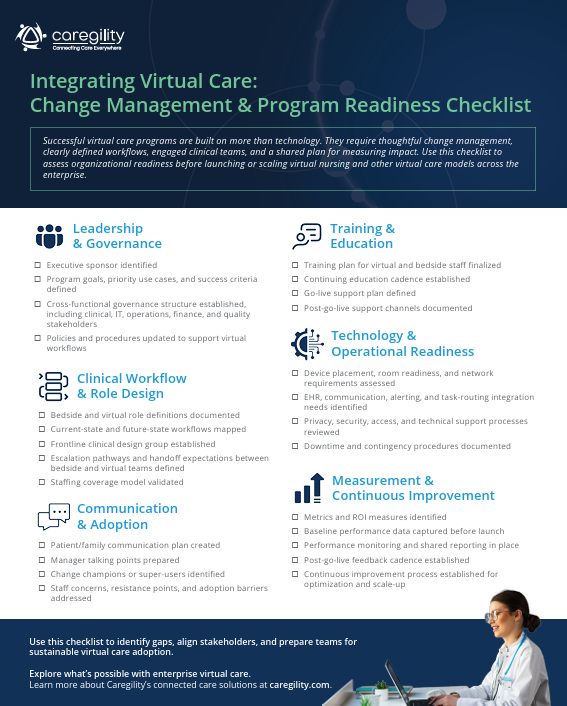
Caregility’s Virtual Care Change Management Readiness Checklist gives clinical, operational, IT, and executive teams a practical framework for assessing readiness before launching or scaling virtual care programs.
Download the free readiness assessment checklist to identify gaps, align internal teams, and build a stronger foundation for enterprise virtual care success.
What’s Inside the Checklist
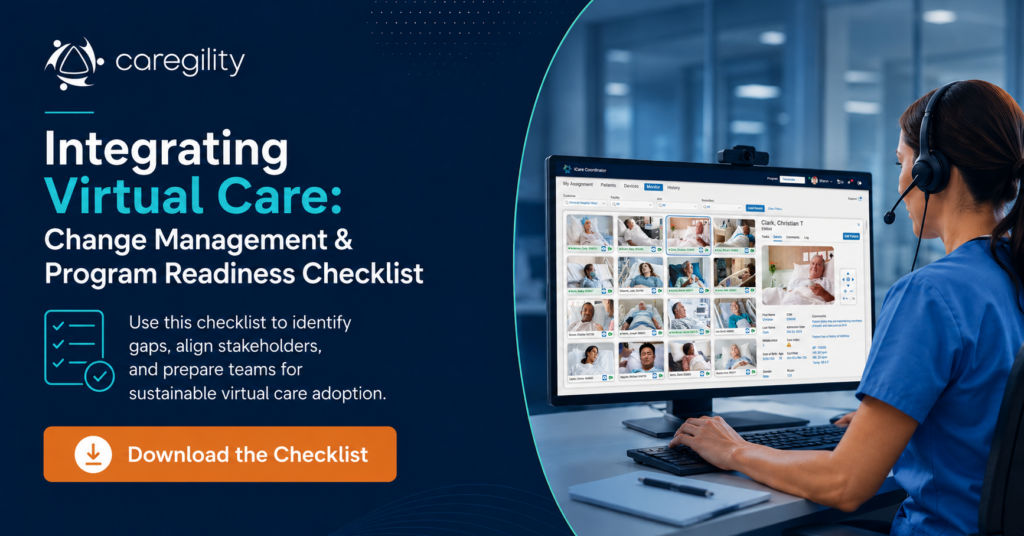
Use the checklist to assess whether your organization has:
Executive alignment and governance
Confirm that program goals, executive sponsorship, governance structures, policies, and success criteria are clearly defined before launch.
Clinical workflow and role clarity
Document how bedside and virtual team members will collaborate, including role definitions, escalation pathways, handoff expectations, and staffing coverage models.
Staff training and go-live support
Prepare virtual and bedside teams with training, education, support channels, and a plan for continued learning after implementation.
Communication and adoption planning
Identify change champions, address staff concerns, prepare manager talking points, and create a patient and family communication plan.
Technology and operational readiness
Assess device placement, room readiness, network requirements, EHR and communication integrations, privacy and security processes, and downtime procedures.
Measurement and optimization
Define ROI measures, capture baseline data, monitor performance, establish feedback loops, and create a continuous improvement process for program scale-up.
If you enjoyed this content, sign up for our newsletter below!
