


Health systems are investing significantly in virtual care to help address workforce challenges, improve access to clinical expertise, support patient safety, and streamline clinical workflow.
As these programs mature, however, leaders are asking a more complex set of questions:
Are we using our virtual care resources as effectively as possible? Which workflows produce the greatest impact? Where are there missed opportunities? How can we translate program activity into a credible financial and operational story? How do we make sure our virtual care program is operating as efficiently and effectively as possible on a continuous basis?
Answering those questions requires more than a count of virtual encounters, monitored patients, or enabled rooms. Health systems need a clearer way to connect virtual care activity with workforce utilization, quality performance, patient experience, operational efficiency, and financial value.
That is the purpose behind Caregility’s Lens on Organizational Performance, or LOOP.
Moving Beyond Utilization
Traditional virtual care reporting often focuses on what happened: how many sessions were completed, how frequently a workflow was used, or which departments generated the most activity. Those measures are important, but they do not always explain what the activity means for the organization and the patient experience.
For example, utilization data alone may not reveal:
- Whether virtual workflows are helping staff work more efficiently
- Where inconsistent adoption is limiting program value
- Which departments have the greatest opportunity for improvement
- How operational changes may affect staffing costs or resource allocation
- Whether virtual care is contributing to quality, safety, or regulatory priorities
- Where the organization should focus during its next phase of expansion
LOOP is designed to close that gap by bringing clinical, operational, financial, and virtual care data into a more unified performance-management framework. Rather than adding another disconnected report, LOOP helps health systems interpret the information they already have and use it to guide decisions.
As Caregility Chief Financial Officer Tod Nestor sees it, “Healthcare leaders should be able to see more than how frequently a technology is being used. They need a defensible understanding of the operational and financial impact they’re producing. This is not only important for ensuring a return-on-investment, but it is also critical to managing and optimizing virtual care programs on an ongoing basis. LOOP helps connect those dots so organizations can identify where value is being realized today and where additional opportunity may remain. It is not simply a point-in-time calculator, but a tremendous tool acting as the management operating system to optimize virtual care programs by floor and system-wide.”
Using the Data Health Systems Already Have
For many organizations, the information needed to assess virtual care performance already exists, but it may be distributed across different systems, departments, spreadsheets, and reports.
Clinical teams may track quality and safety indicators. Finance may monitor labor expenses, productivity, and departmental performance. Virtual care leaders may review technology utilization. Operational teams may maintain separate workflow or staffing data. Bringing those sources together can be time-consuming, and the analysis may arrive too late to influence meaningful change.
LOOP is intended to reduce that burden. Caregility works with customers to combine relevant organizational information with Caregility utilization data, helping reveal relationships that may not be visible in standard reports. The result is not simply a retrospective account of program activity. It is a more actionable view of:
- Current performance
- Historical trends
- Variations among departments or facilities
- Potential operational and financial opportunities
- Areas that may require renewed workflow adoption
- Logical next steps for program optimization or expansion
The process is designed to use data the organization already collects, without requiring protected health information or a major new data-gathering initiative.
Understanding Realized and Unrealized Value
One of the most useful questions LOOP can help organizations explore is the difference between the value a program is currently producing and the value it could potentially deliver. A health system may have the technology and workflows needed to support virtual nursing, patient observation, specialty consultation, or other connected care programs. Yet adoption may vary considerably among units. One department may use the program consistently, while another with similar staffing pressures or patient needs may use it only occasionally. A workflow may be integrated across an organization but not yet operating at the volume needed to generate its full potential benefit.
By examining performance at the organizational, facility, service-line, and departmental levels, LOOP can help leaders identify where variation exists and what may be driving it. That insight can support practical decisions, such as:
- Reengaging departments where adoption has slowed
- Refining staffing and coverage models
- Standardizing effective workflows across facilities
- Directing training and change-management resources
- Identifying the next departments or use cases for expansion
- Establishing baselines for future performance comparisons
In this way, LOOP is intended to be more than a one-time ROI calculation. It provides a framework for continuously evaluating how a connected care program is performing and where it should go next.
Connecting Financial and Clinical Priorities
The value of virtual care cannot be evaluated through a financial or clinical lens alone. A workflow that reduces labor requirements may also help clinicians spend more time on direct patient care. A program that supports fall prevention may contribute to patient safety, regulatory preparedness, and cost avoidance. Better access to experienced virtual nurses may help bedside teams manage workload while supporting less-experienced staff.
LOOP brings these perspectives together so that finance, nursing, operations, quality, and technology leaders can work from a more consistent view of performance. For nursing executives, that level of detail is especially important. Today’s department leaders are responsible not only for clinical quality but also for productivity, staffing, budgets, workforce sustainability, and regulatory performance.
“Nurse leaders are being asked to manage quality, workforce performance, productivity, and financial stewardship at the same time. They have become the CEOs of their clinical areas,” noted Caregility Chief Nursing Officer Susan Kristiniak, DHA, MSN, RN, NEA-BC, AHN-BC. “LOOP gives them a clearer view of how those factors intersect. It can help leaders identify where support is needed, recognize where teams are performing well, and give department managers information they can use to take meaningful action.”
The insights will help organizations’ leaders prepare conversations about quality reporting, patient-safety initiatives, budgeting, executive reviews, and future capital planning.
LOOP does not replace required regulatory reporting systems or local financial analysis. Instead, it can help surface and organize the utilization, workflow, productivity, and quality indicators that inform those activities.
From Measurement to Continuous Improvement
Virtual care performance should not be evaluated only when an organization is preparing a budget request or deciding whether to renew a technology investment. Measurement should be part of the program’s ongoing lifecycle:
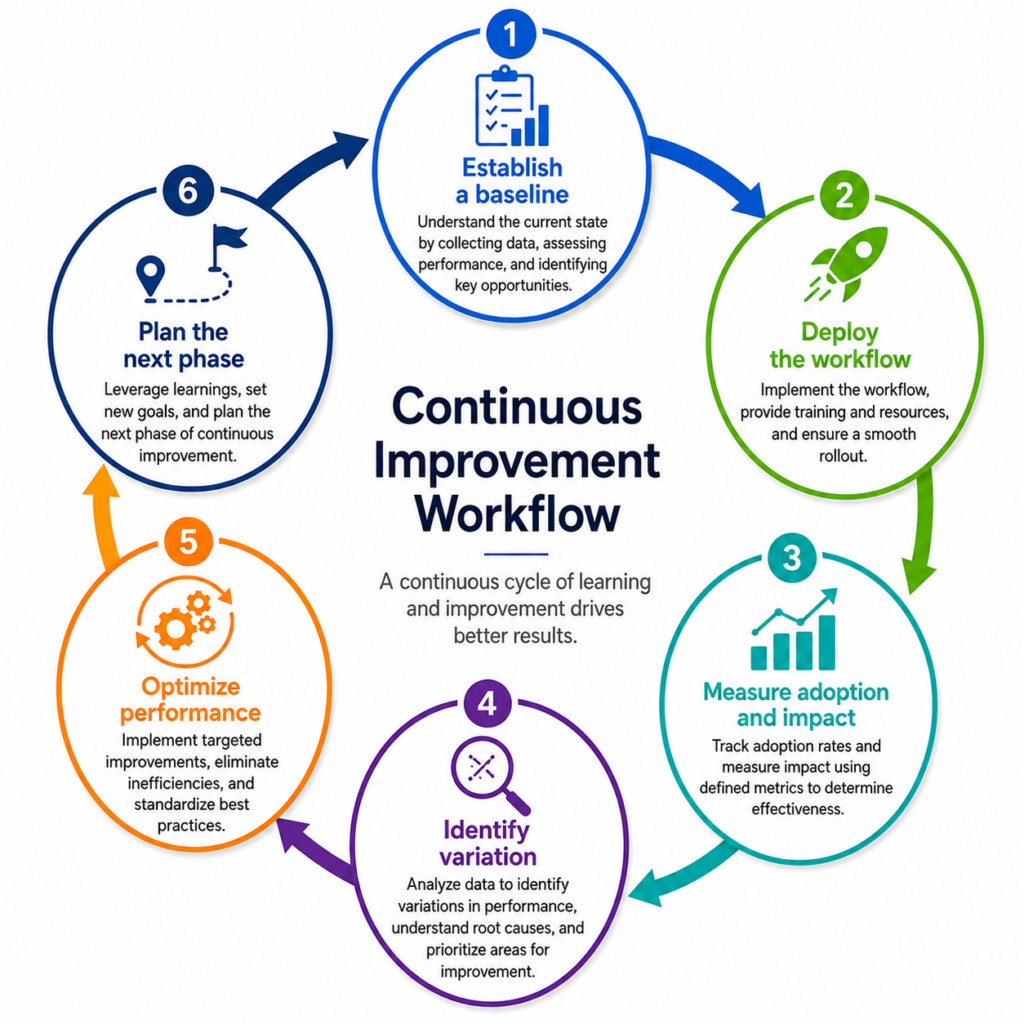
Because LOOP can be applied at different stages of program maturity, organizations do not necessarily have to wait until a large-scale deployment is complete.
Before implementation, LOOP can help establish baselines, measurement priorities, and key performance indicators. Once workflows are live, those baselines can support pre- and post-implementation comparisons. As the program expands, the same framework can help leaders examine trends, compare departments, and assess new opportunities. Even if your virtual care program has already been deployed, LOOP can measure the pre- and post-implementation impact to assist in measuring your program’s success.
Over time, that creates a more repeatable approach to performance management—one that evolves alongside the organization’s virtual care strategy.
The central question is straightforward: How much more value could your virtual care program be delivering?
Explore Your Virtual Care Opportunity at the Caregility Customer Summit
Caregility customers attending the 2026 Caregility Customer Summit will have an opportunity to continue the LOOP conversation through dedicated one-on-one sessions with Caregility’s clinical and financial leaders. These working discussions allow participating customers an opportunity to explore their current program, consider potential cost-saving and performance-improvement opportunities, and learn how LOOP could support future business and operational reviews.
Customers will receive a personalized LOOP Scorecard and have an opportunity to explore the broader reporting and assessment resources Caregility developed to support virtual care performance management. Because the analysis is specific to each health system, these conversations are intended to go beyond generic benchmarks. They begin with the organization’s own goals, workflows, operational realities, and available data.
Caregility customers can register for the Summit event, taking place in collaboration with UMass Memorial Health in Worcester, MA, Oct. 1-2, here. Or you can learn more by setting up a LOOP performance assessment discovery call today.
