


Case Study
Baptist Health Scales Virtual Nursing to Expand Connected Care Across Arkansas


As rising patient volumes, workforce shortages, and clinician burnout placed greater pressure on care teams, Baptist Health set out to build a more sustainable approach to care delivery. Starting with virtual nursing and observation programs and expanding through a centralized virtual care hub at Baptist Health Medical Center–Little Rock, the health system created a scalable model designed to reduce bedside burden, improve throughput, and extend clinical expertise across facilities.
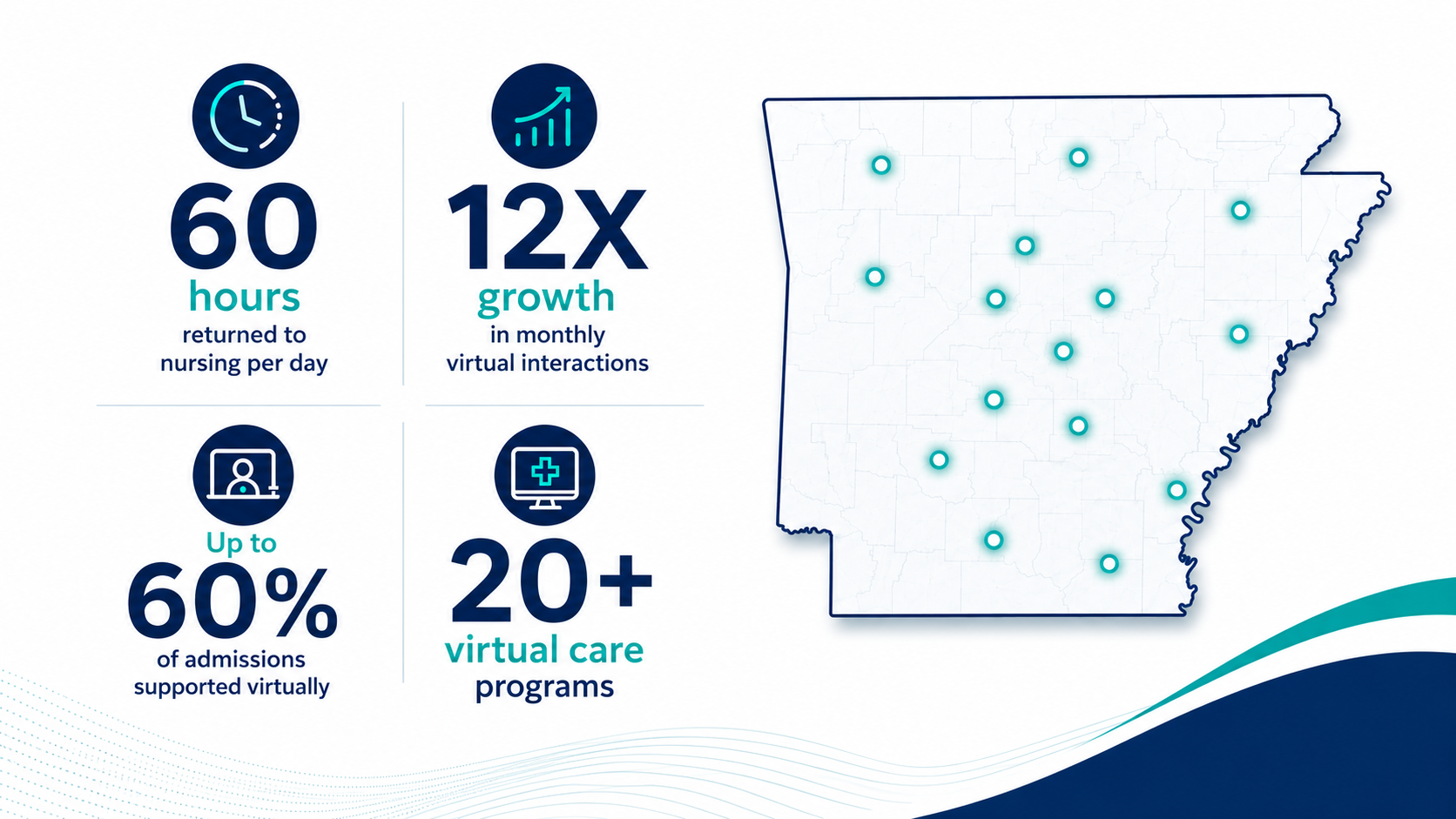
Today, Baptist Health’s virtual care program supports a growing range of workflows, including virtual nursing, observation, behavioral health, specialty consults, and other connected care services. With more than 20 virtual care programs and hundreds of Smart Room endpoints deployed or in progress, the initiative demonstrates how virtual care can help healthcare systems create more resilient staffing models while preserving time for direct patient care.
About Baptist Health
Baptist Health is Arkansas’s largest not-for-profit healthcare system, serving patients through hospitals, clinics, rehabilitation services, and specialty programs across the state.
Its virtual care journey began with eICU in 2005 and evolved to include virtual nursing, observation, and specialty care across multiple facilities. In 2024, Baptist Health opened a centralized Virtual Care Center at its Little Rock campus, creating a scalable model for extending experienced clinicians, supporting bedside teams, and standardizing virtual care delivery.
Today, Baptist Health uses virtual care to reduce bedside burden, improve care coordination, and create new opportunities for experienced nurses while building a stronger foundation for connected care across the health system.
The Challenge
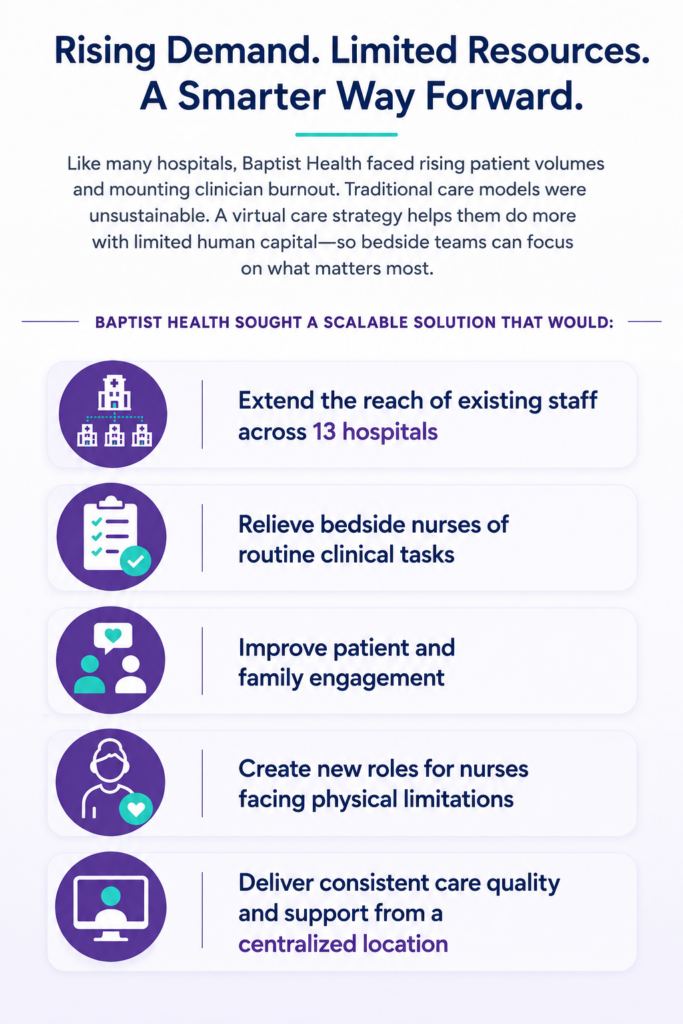
Like many healthcare systems, Baptist Health faced a combination of rising patient demand, workforce shortages, nurse burnout, and growing administrative responsibilities. Bedside nurses were managing direct patient care while also handling admissions, discharges, documentation, care coordination, patient education, and other time-intensive activities.
These pressures created an increasingly difficult balance. Every hour spent on routine administrative or coordination tasks represented time that could not be dedicated to direct patient care. As patient volumes grew, simply adding more staff was not always feasible.
Baptist Health recognized that traditional staffing models alone would not be enough to meet growing care demands. The system needed a way to extend the reach of experienced clinicians, support bedside teams more consistently, and create a common care delivery model that could scale across hospitals of different sizes and in different communities.
The Solution
Baptist Health partnered with Caregility to deploy Smart Room devices and a centralized virtual care hub at its Little Rock campus. The team adopted a phased implementation approach, piloting virtual observation to mitigate fall risk and evolving into a comprehensive virtual nursing model.
Key elements of the program included:

Centralized Virtual Hub
Virtual clinicians are co-located to foster teamwork, enable consistent staffing, and ensure standardized care delivery.

Flexible Workflows
Remote nurses support a range of services including admissions, discharges, rounding, and family communication

Bedside Alignment
In-person and virtual staff engage in “press tours” and onboarding to promote collaboration and reinforce the supportive nature of virtual care.

Data-Driven Feedback Loops
Real-time insights and staff feedback inform ongoing program adjustments and scaling strategies.
The Outcomes
Baptist Health’s virtual care strategy has delivered measurable operational and workforce impact while creating a foundation for continued growth.
- 12X Growth in Virtual Interactions
Monthly virtual patient encounters grew from ~300 to over 3,800 within the first year. - 60% of Admissions Supported Virtually
On some units, virtual nurses now handle up to 60% of all admissions—reclaiming ~60 minutes of RN time per patient. - Improved Throughput
Earlier discharges, enabled by virtual support, created more capacity across med-surg units. - Career Redeployment
Nurses unable to perform bedside duties due to injury or burnout found renewed purpose in virtual roles, improving morale and retention. - Enhanced Patient Satisfaction
Observers provided not only safety monitoring but also emotional support—chatting with anxious or lonely patients and helping families stay connected.
What Comes Next
Baptist Health continues to expand Smart Room deployment across medical-surgical units while deepening integrations with Epic and other clinical systems. The long-term vision is to create “aware rooms” capable of surfacing relevant information to virtual clinicians in real time.
The team is also continuing to refine its approach to measuring return on investment, with areas of interest including nurse satisfaction, readmissions, length of stay, patient experience, retention, throughput, and utilization.
By building on the same virtual care infrastructure across nursing, observation, behavioral health, specialty consults, and other services, Baptist Health is creating a connected care model designed to support both today’s workforce challenges and tomorrow’s AI-enabled hospital.