



Author: Kedar Ganta, Chief Product, Technology, and AI Officer, Caregility
Following my December 2025 update, I received feedback from a hospital system that had deployed our Virtual Observation program across multiple units:
“We still have blind spots we cannot ignore – especially in spaces where cameras simply can’t go.“
That comment captures the tension we face in healthcare: how do we extend patient safety everywhere it’s needed while still respecting dignity and privacy?
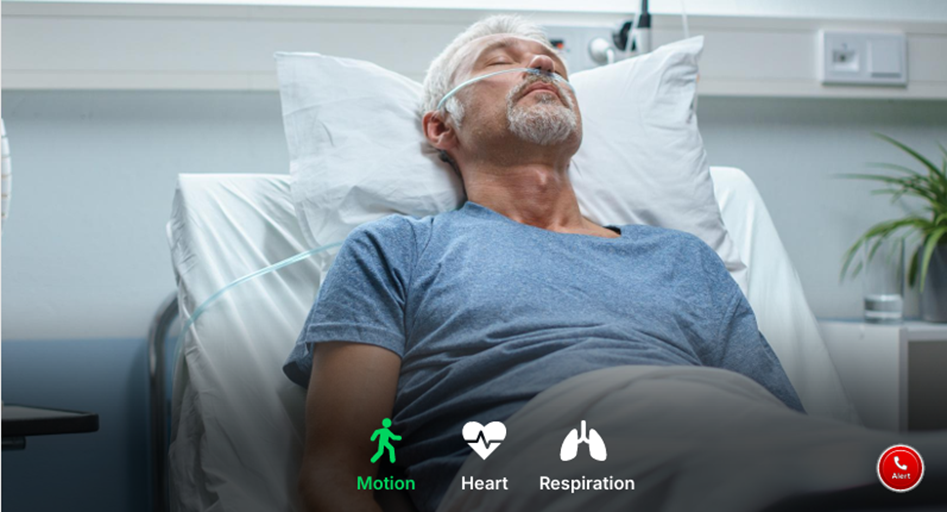
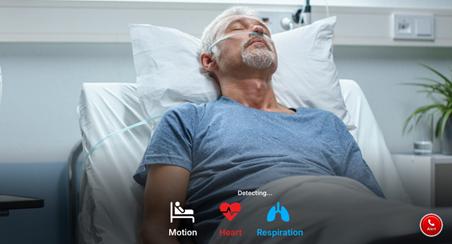
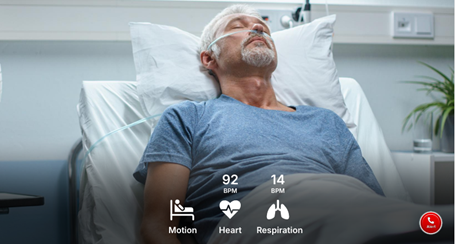
One innovation I’m particularly excited about showcasing is our Radar-Based Monitoring – a silent observer in spaces where cameras don’t belong, such as restrooms and other privacy-sensitive areas. It is designed to act as a second layer of awareness, expanding monitoring capabilities while preserving patient dignity.
Join Us at HIMSS
We’re looking forward to presenting our latest innovations at the HIMSS Global Health Conference in Las Vegas. Stop by our booth 3511 to see our ‘Hospital Room of the Future’ exhibit, where we will showcase technologies that extend monitoring into spaces where cameras can’t reach.”
We’re also expanding what’s possible with sound captured directly from devices in patient rooms. This includes voice commands that allow patients and staff to trigger hands-free actions, monitor decibel levels for a more comfortable healing environment, and ambient documentation captured directly at the point of care.
We’ll also feature the AI Playback alongside our CUBE AI Server – both designed for operational realities of real-world hospital environments. We will be demonstrating these practical innovations, built responsibly, and designed to improve care in real hospital environments.
CUBE: Your Continuity Server
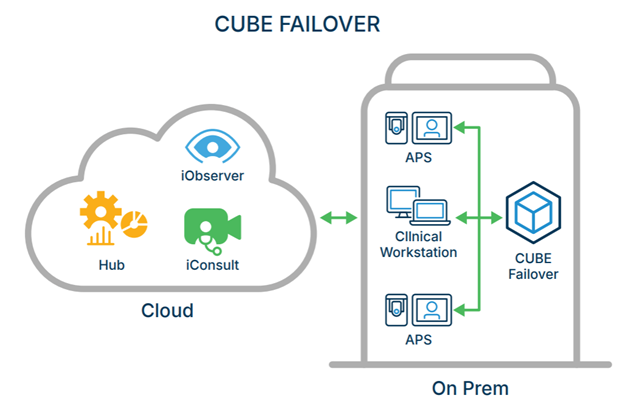
We’re introducing the CUBE server – Caregility Cloud Continuity Server. It’s designed for the scenario no one wants to think about, but everyone needs to prepare for: what happens when a disaster strikes?
When a hurricane hits, when a ransomware attack locks down your network, when a major cybersecurity incident cuts off access beyond your hospital network walls, CUBE keeps your virtual care running.
It’s a local failover that maintains care delivery continuity even when everything outside your four walls is disrupted. The financial and clinical impact of losing virtual care during a crisis is significant. CUBE is designed to eliminate that risk. We also offer CUBE AI server, a version that processes large AI workloads locally, extending our edge-first architecture.
January Platform Release
In January, we delivered significant workflow, intelligence, and compliance enhancements across iObserver, iConsult, our endpoints, and Control Hub.
iObserver Brings Smarter Monitoring Workflows
- You can now download HL7 audit logs that capture names, encounter details, dates and times – the kind of record keeping that compliance teams need, and clinical teams increasingly rely on.
- When clinicians and observers join the same session, we now share camera position signals between them. If an observer zooms to 5x or switches to 40x, clinicians can see which view is active to prevent confusion.
- Session-transfer intelligence now preserves privacy mode settings and recording status when handing off a patient from one observer to another. These states persist through a successful transfer, ensuring continuity during handovers and shift changes.
iConsult Inpatient Consultation Enhancements
- iConsult calls now feature default blurred background for better privacy during consultations.
- We now support ‘second spotlight’ to keep the patient visible to ASL interpreters, allowing them to maintain visual contact for hearing impaired participants.
- iConsult calls can be placed directly from Epic Mobile Apps (Rover, Canto, Haiku), with better interpreter lookup for language assistance.
- Devices now display a busy message when occupied with another call, while maintaining auto-answer capabilities on bedside patient apps.
Control Hub Gets Better Visibility
- Our command center is looking sharper with advanced reports (beta) for clinical notification.
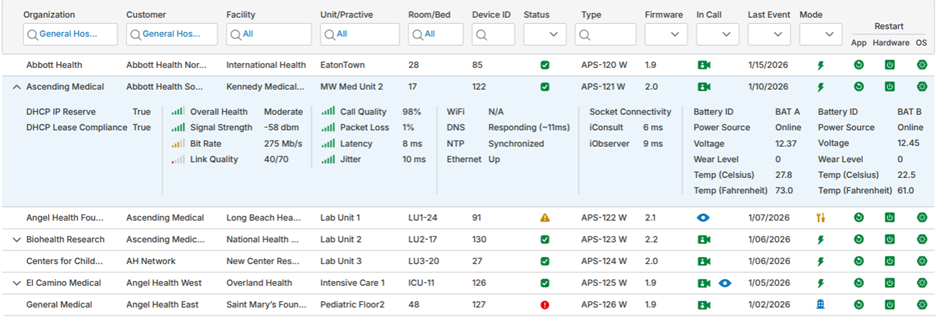
- Administrators can now view device connectivity status while devices are on standby and during active use, helping teams proactively monitor performance and manage their device fleet more effectively.
- Track calls that are answered on the first push versus those requiring multiple attempts, with average response times for benchmarking. Drill down by program, call type, organization level, or individual user.
- With up to 24 months of data visualization, you’ll gain insights you need to make informed operational decisions.
- See which camera endpoints and tablets are online, offline, in a call, or inactive – visibility that helps teams manage endpoints and reduce disruptions across care environments.
- Administrators can now better manage and plan the replacement of their Caregility carts’ batteries with battery health stats.
Endpoints Get Even Smarter
Our AI-augmented observation continues to evolve. The platform uses computer vision to detect when patients are standing, sitting, or lying in bed, capturing mobility signals that matter to clinicians.
We also applied computer vision to solve a common operational problem. When cleaning protocols require physical camera adjustments, cameras can lose their home position. Our latest release uses computer vision AI to quietly instruct camera endpoints to automatically resync to the privacy bookmark position without distracting the patient. This is the kind of practical intelligence that makes our endpoints truly smart.
Our approach to AI is deliberate, embedding intelligence that reduces friction without increasing cognitive load.
Continuing Our Focus on Intelligent Expansion
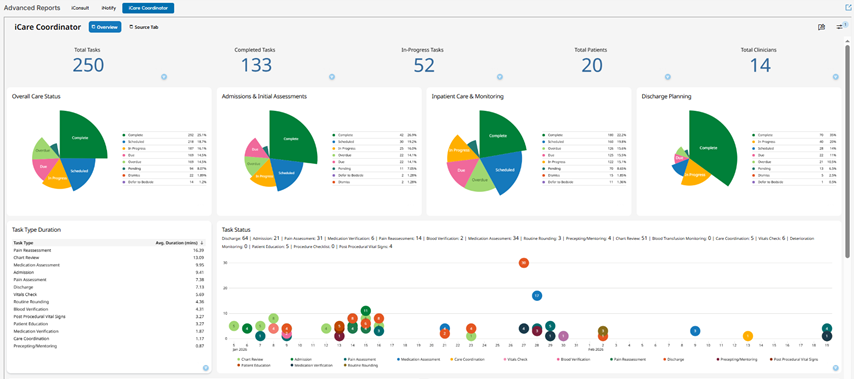
If you missed it, check out our recent announcement about AI-enhanced unlimited patient monitoring in iCare Coordinator. That adds unlimited continuous monitoring across patient rooms, limited only by individual choice. This means nurse managers now have a unified, real-time view of all rooms in a unit, giving them situational awareness. The vision is to bring AI into the mix to help caregivers act faster and smarter every day.
I look forward to meeting many of you at HIMSS!
Contact us to learn how the latest Caregility updates support your connected care strategy!
