Virtual Workflows that Boost Emergency Room Throughput & Revenue
Video
On Demand Webinar: Virtual Workflows that Boost Emergency Room Throughput & Revenue
Webinar: Virtual Workflows that Boost Emergency Room Throughput & Revenue
Emergency departments are under constant pressure to balance rising patient demand, limited staff resources, and increasing financial constraints. In this webinar, industry leaders shared proven strategies for using virtual workflows to streamline throughput, improve patient experience, and strengthen the bottom line.
Now available on demand, this session hosted by Caregility CNO Susan Krisiniak and EmOpti CEO Ed Barthell explores how innovative care models and technology are transforming the way emergency teams work—helping hospitals achieve better outcomes for both patients and providers.
What You’ll Learn:
In this session, you’ll discover how to:
Improve patient experience through faster intake and reduced ED bottlenecks.
Enhance clinical efficiency with technology-enabled workflows that free up staff time.
Boost operational performance with data-driven approaches to throughput.
Strengthen your financial outcomes by capturing revenue that’s often lost in inefficient processes.
Schedule a Discovery Call to Learn More
One Platform, Endless Possibilities
With intuitive clinical applications, purpose-built endpoints, an unparalleled integration ecosystem, and edge AI capabilities, the Caregility Connected Care™ platform helps you bring patients, bedside staff, remote support, and AI together at the point of care to improve patient care and outcomes.
Safety Scores and CMS Dollars
On-Demand Webinar
Safety Scores and CMS Dollars
With new CMS reporting requirements for the Hospital Inpatient Quality Reporting (IQR) Program beginning in 2025, hospitals must navigate significant changes to maintain compliance and avoid financial penalties.
In this on-demand webinar, Caregility CNO Susan Kristinak explores actionable strategies to align your organization with these measures, leveraging the power of AI and telehealth to enhance compliance and improve care delivery. Attendees will gain insights into effective interventions, innovative data capture methods, and leadership strategies to not only meet CMS requirements but also strengthen patient safety and engagement across their organizations.
Lessons Learned in 2024: Insights & Strategies from Virtual Nursing Go-Lives
On-Demand Webinar
Lessons Learned in 2024: Insights & Strategies from Virtual Nursing Go-Lives
In this on-demand webinar, we take a candid, behind-the-scenes look at virtual nursing in 2024, as our team shares real-life experiences from over a dozen health system rollouts. In this engaging, roundtable-style conversation, our clinical experts discuss innovative implementations, unexpected challenges, and key successes that shaped 2024’s virtual nursing go-lives.
Key Takeaways:
Identify innovative applications of virtual nursing that enhanced patient care and streamlined workflows in 2024.
Understand critical success factors and common pitfalls in virtual nursing implementations, with practical troubleshooting examples.
Recognize key benefits health systems realized with virtual nursing, from improved patient engagement to increased clinical efficiency.
Get expert advice on planning and executing a virtual nursing program, including effective preparation and post-implementation strategies.
Hybrid Care Innovation: The ROI of Remote Bedside Engagement
On-Demand Webinar
Hybrid Care Innovation: The ROI of Remote Bedside Engagement
In this on-demand webinar, hosted by Becker’s Healthcare as part of their 2024 Digital Health + Telehealth Virtual Event, David Smith, Senior Director of Digital Innovation at UMass Memorial Health System, and Mike Brandofino, President and COO of Caregility, discuss the strategic advantages of extending virtual care to every patient room, best practices for navigating change management in the shift to hybrid care models, and how to create an integrated digital health infrastructure built for long-term success.
Topics Include:
Hybrid care models UMass has implemented to elevate the standard of care for patients and staff
How to cost-justify your programs and key hard and soft ROI factors
What it takes to scale virtual care to every patient bedside
Advice for other health systems pursuing similar innovation
Hospital Leaders Weigh in on Virtual Nursing
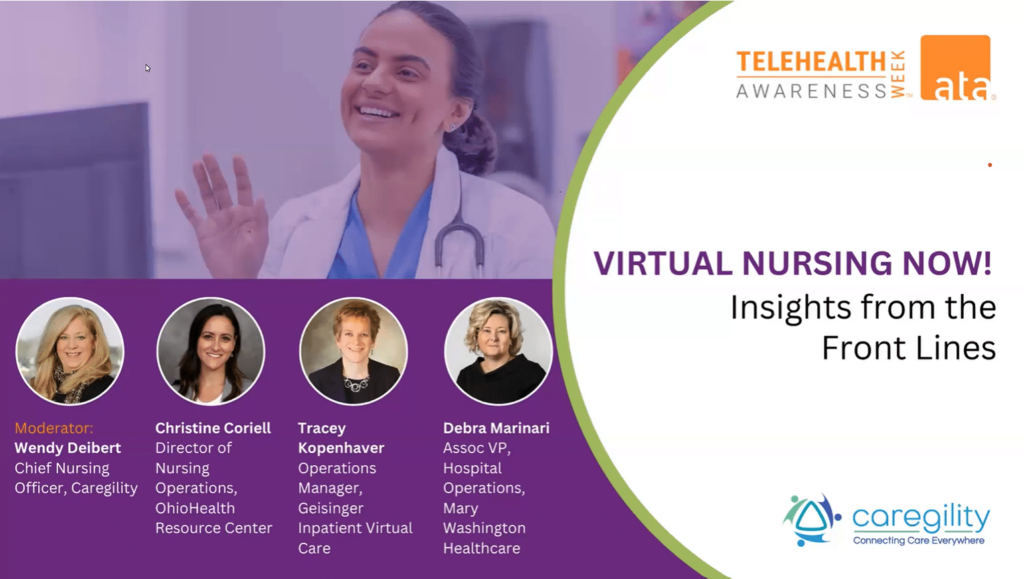
Healthcare delivery is undergoing a transformation and virtual nursing is at the forefront. In a recent webinar co-hosted by Caregility and the American Telemedicine Association (ATA), healthcare leaders from institutions at various stages of implementing Virtual Nursing programs gathered to discuss their experiences.
Virtual care pioneer and Caregility CNO Wendy Deibert led the illuminating panel discussion featuring Tracey Kopenhaver, Operations Manager, Geisinger Inpatient Virtual Care; Christine Coriell, Director of Nursing Operations, OhioHealth Resource Center; and Debra Marinari, Associate Vice President, Hospital Operations, Mary Washington Healthcare.
All panelists pointed to nursing workforce challenges as key motivators to pursue Virtual Nursing, but technology and ROI had to line up.
Addressing Nursing Shortages and Burnout
The virtual nursing model allows healthcare organizations to tackle staffing shortages and burnout by distributing the workload more evenly.
“We were motivated by a few things – primarily the nursing shortage, nurse turnover, nurse burnout, and really looking at our care team redesign. Looking at current state, where we don’t have quite enough nurses to go around, and our nurses are overworked and busy and can’t get to all the things that they need to do in a day… How can we try to future-proof or buffer that?” – Tracey Kopenhaver
Technology Aligns with Strategic Goals
By leveraging existing technology that supports remote patient observation teams and tele-ICU programs, Virtual Nursing programs align well with strategic goals to centralize and scale virtual care.
“When we think about our Nursing strategic goals at OhioHealth, one is having a flexible workforce and second is maximizing the technology we have at OhioHealh. So, this was just a natural next step into the virtual world.” – Christine Coriell
Demonstrated ROI
Panelists addressed the importance of justifying costs, typically vetted through pilot programs.
“It had to be cost neutral – that’s the model that we took. So, we had to make sure that whatever we brought in was going to have a good return on investment – not just the quality metrics, but [improving] satisfaction and decreasing turnover.” – Debra Marinari
Strategy
While there is variation in how Virtual Nursing workloads are assigned within each organization, some standard practices emerged. Each panelist’s healthcare organization uses Epic’s EHR in different capacities for streamlining workflows. Each organization also staffs virtual nurses onsite, with Geisinger employing a hybrid model that also includes nurses working from home.
Getting Started
“The number one recommendation I would give to anybody who is thinking about starting a virtual nurse program is don’t let perfection get in the way of progress. We started very low budget. We repurposed carts. We hired per-diem staff to start with and borrowed some staff from our virtual ICU program. We really went in on a shoestring to get it off the ground. We’ve been able to demonstrate the return and we have the financial support to move ahead with a more permanent solution.” – Tracey Kopenhaver
Staffing Models
Virtual nurse staffing models varied across panelists. Coriell noted that, in their current phase, OhioHealth virtual nurses work Monday through Friday from 7 a.m. to 7 p.m., with plans to extend to 24/7 coverage.
“The virtual nurse will be assigned to patients that all will roll up to the many nurses overseeing that care at the bedside. We’re utilizing a flex team of nurses with knowledge across different care sites for now. A future focus is on having dedicated full-time employees (FTEs) for the program.” – Christine Coriell
Geisinger takes a slightly different approach, with Virtual Nursing overseeing specific tasks.
“There are no specific patient assignments for virtual nurses since they currently focus mainly on admissions and discharges.” – Tracey Kopenhaver
Meanwhile, Marinari and the Mary Washington Healthcare team elected to bring on additional FTEs for virtual nursing from the very beginning.
“The model had to be really such that the nurses at the bedside did not feel like they had less resources, but actually more. We had to balance the FTEs for each of the departments, and what that workload was going to be [in terms of] patient ratios. The virtual nurses are assigned to patients, currently managing around 15 to 16 patients during the day and up to 20 at night.” – Debra Marinari
Goals and Results
Positively impacting nurse and patient experience are core objectives for each organization.
KPIs
“Key outcomes that we really want from this program [include] retention of nurses, decreasing that workload and stress at the bedside, increasing time for the bedside nurses to be able to provide care for their patients, improving nurse satisfaction [and] patient satisfaction, and then some cost savings. Ultimately, we would look at time saved with length of stay and a few other metrics as well.” – Christine Coriell
“We’re looking at our HCAHPS – nurse responsiveness and communication with the nurse scores in particular.” – Tracey Kopenhaver
Time Management & Efficiency
All panelists agreed that virtual nursing significantly improves time management, reducing the workload of bedside nurses.
“The thing that we’ve been able to measure the most is the time saved for the bedside nurses.” – Tracey Kopenhaver
Marinari and the Mary Washington Healthcare team conducted time studies to demonstrate time savings, assessing the time from when the discharge order is written to the time the patient leaves as a metric. Coriell highlighted the role of existing relationships between virtual nurses and unit staff in speeding up tasks and improving efficiency.
Conclusion
Virtual Nursing programs are not just a trend; they are a substantial step toward enhancing healthcare delivery. These programs alleviate staff burnout, improve patient experience, and provide financial returns. With insights from leaders in the field mounting, it’s clear that Virtual Nursing is a viable and vital part of the future of healthcare.
Virtual Nursing Now – Insights from the Front Lines
On-Demand Webinar
Virtual Nursing NOW! Insights from the Front Lines
Virtual Nursing programs are transforming care delivery. By introducing access to remote nurses at the hospital bedside, health systems are enhancing patient safety, improving workflow efficiency, and reducing burnout for bedside teams as staffing shortages persist.
In this virtual panel discussion, leaders from a cross-section of healthcare institutions at various stages in their journey share their experiences with Virtual Nursing pilot programs, early results they’ve seen, and lessons learned along the way.
What You’ll Learn:
How to get started with virtual nursing
How to unify bedside and virtual nursing teams
Real-world benefits of virtual nursing
How to cost justify your telenursing program
Virtual Nursing’s Impact on Patient Experience
Virtual Nursing: From Concept to Impact
On-Demand Webinar
How to Take Virtual Nursing from Concept to Impact
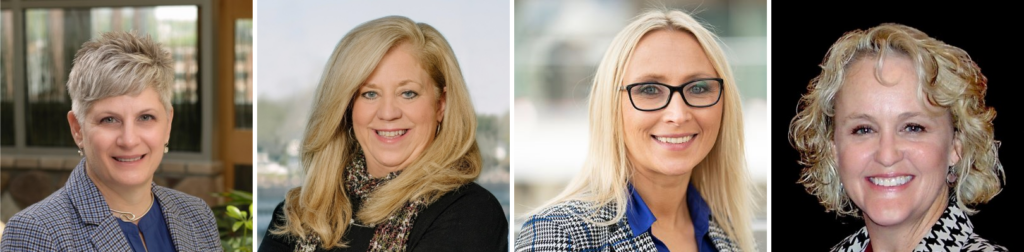
Panelists (left to right):
Kris Chaisson, SVP & CNO, Central Maine Healthcare
Wendy Deibert, CNO, Caregility
Marcia Murphy, VP, Clinical Operations & Nursing, Hicuity Health
Theresa Rincon, Sr. Telehealth Consultant, Blue Cirrus Consulting
Topics:
Market factors driving Virtual Nursing adoption
Virtual Nursing use cases and workflow examples
First steps when getting started with Virtual Nursing
Building a Business Case for Virtual Nursing
Change Management’s Role in Virtual Nursing
Virtual Nursing staffing ratios and best practices
How to build trust between staff and Virtual Nurses
Virtual Nursing’s role in assisting the novice nurse
How to measure Virtual Nursing Program success
Financial implications of Virtual Nursing
Looking for guidance on how to implement, optimize, or expand your Virtual Nursing Program?
Our nurse Clinical Program Managers are available to help!
A Guide to Virtual Nursing: Post-Acute Settings
On-Demand Webinar
A Guide to Virtual Nursing: Post-Acute Settings
From the hospital bedside to Hospital-at-Home, virtual nursing programs across the care continuum are helping clinical teams improve patient care, reduce readmissions, and better manage costs.
Learn about the practical application of virtual nursing in post-acute preparation and care in the second installment in our webinar series, “A Guide to Virtual Nursing: Post-Acute Settings.”
Caregility nurses Donna Gudmestad and Heidi Steiner address ways virtual nursing helps overcome staffing challenges, streamline care transitions, and improve patient outcomes in post-acute care.
Want to learn more?
Set up a call with our clinical workflow experts to explore virtual nursing for your health system’s unique needs.
A Guide to Virtual Nursing: Inpatient Settings
On-Demand Webinar
A Guide to Virtual Nursing: Inpatient Settings
As hospitals and health systems strive to offer high-quality patient care in an efficient, cost-effective way, many are turning to hybrid care models that bring virtual workflows into bedside processes. Virtual nursing programs help healthcare organizations recoup vital bedside time for nurses, reduce blind spots for care teams, and improve patient coverage and safety. This enables hospitals to support more patients without overextending resources – a critical need as nurse staffing shortages persist.
Learn how to implement virtual nursing programs that support acute care workflows across the enterprise in the first installment in our webinar series, “A Guide to Virtual Nursing: Inpatient Settings.”
Caregility Clinical Program Managers Donna Gudmestad and Ben Cassidy address the ways virtual nursing helps health systems overcome staffing challenges, improve patient outcomes, and enhance bedside workflows for care teams.
Best Practices When Deploying, Managing & Monitoring a Virtual Sitter Program
On-Demand Webinar
Best Practices When Deploying, Managing & Monitoring a Virtual Sitter Program
There are so many factors that go into ensuring your virtual sitter program is a success. Everything from creating the business case, deciding on the best model, selecting the right partner, educating the staff, and ensuring a smooth rollout. Not to mention the subsequent management, monitoring, and reporting requirements.


 In this on-demand webinar, we take a candid, behind-the-scenes look at virtual nursing in 2024, as our team shares real-life experiences from over a dozen health system rollouts. In this engaging, roundtable-style conversation, our clinical experts discuss innovative implementations, unexpected challenges, and key successes that shaped 2024’s virtual nursing go-lives.