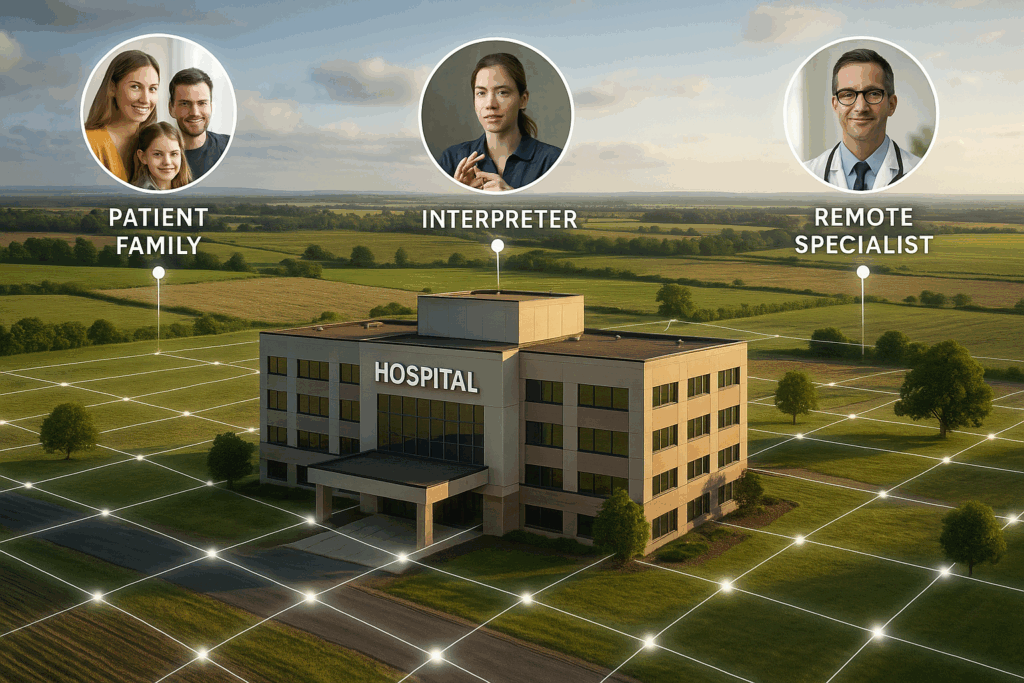
A Turning Point for Rural Health: How States, Systems, and Digital Health Leaders Are Shaping What Comes Next
Rural America is in the middle of a rare and powerful moment of alignment. For decades, rural hospitals have been fighting a multidimensional battle: shrinking workforces, widening access deserts, aging populations with rising acuity, and tightening financial margins that make every operational decision existential.
This year, that burden meets an unprecedented opportunity.
Through the One Big Beautiful Bill Act, Congress authorized the $50 billion Rural Health Transformation Program (RHTP), a five-year infusion designed to help states rewrite the future of rural care delivery. States submitted their proposals to CMS in early November, and final funding decisions are expected by December 31, despite federal shutdown delays that required HHS to call furloughed reviewers back to keep things moving.
What happens next will determine whether this becomes a once-in-a-generation modernization of rural healthcare or another fleeting cycle of short-term relief.
Rural Health Needs are Urgent and Growing
Rural communities face higher rates of chronic disease, behavioral health needs, maternal health risks, and care access barriers. The workforce picture is equally stark:
About 20% of the US population lives in rural areas, but only 9-11% of the nation’s physicians practice in rural communities. 1
74% of rural hospital CEOs report needing more RNs. 2
RN staffing density is substantially lower in rural areas versus metro areas, with roughly 65 RNs versus about 100 RNs per 10,000 patients, respectively. 3
Some analyses suggest that a single transferred patient may represent a lost contribution margin of roughly $10,000, a financial reality that compounds the pressure to maintain local access.
Against this backdrop, telehealth stands out as one of the most consistently emphasized modernization levers. In fact, “telehealth” appears 36 times in the RHTP framework, a signal that virtual care is essential to achieving the program’s goals.
Early Signals: How States Plan to Use Funding
Several states have already taken the lead in publicly sharing their RHTP applications, demonstrating an unusual level of transparency for a grant program of this scale. Details from early applications and announcements include:
Maine proposes $200,942,115 over five years to expand telehealth access statewide. 4
Washington plans to allocate $15–18 million annually toward a statewide Provider Technology Fund. 5
Maryland, one of the first states to publish its proposal, emphasizes broad community engagement and technology-enabled care expansion. 6
These early examples show a common thread: states are prioritizing digital infrastructure, care innovation, and workforce sustainability, even though the strategies vary. In a review of 25+ state RHTP announcements, roughly 90% of states included telehealth hub or network language to advance specialist access through programs like tele-stroke, tele-ED, and tele-behavioral health. Workforce reinforcement and mobile telehealth access were also highlighted as key initiatives by many states.
Some may centralize funding through statewide contracts. Others will distribute funds through competitive grants, regional collaboratives, or direct sub-awards to rural facilities. This variation matters and hospitals that prepare early will have the most to gain.
What Rural Leaders Should Be Doing Right Now
During our recent National Rural Health Association (NRHA) webinar, four national thought leaders – Connor Communications Grant Strategist Angela Connor, MA; Caregility CNO Susan Kristiniak, DHA, MSN, RN, NEA-BC, AHN-BC; Health Recovery Solutions CEO Jason Comer, JD; and Equum Medical Chief Marketing Officer Karsten Russell-Wood, MBA, MPH – outlined a clear path forward for rural health organizations preparing for RHTP funding.
Here are the key themes they shared.
1. Prepare: Understand Your State’s Plan and Build Your Own
With RHTP approvals coming soon, Connor underscored the importance of early readiness, encouraging hospitals to:
Review their state’s posted RHTP application to understand priorities, timelines, and distribution models.
Contact their State Office of Rural Health, which will be central to coordinating sub-grants.
Define strategic needs now, rather than waiting for a grant window to open.
Build programs “as if budget weren’t the constraint,” to respond quickly and convincingly.
The takeaway: When states begin awarding funds, hospitals with clear, shovel-ready initiatives will be far ahead of those still brainstorming.
2. Repair: Rebuild Workforce Capacity with Connected Care Tools
Kristiniak brought the inpatient lens to the conversation: rural workforce strain isn’t theoretical. It shows up in fall rates, throughput challenges, safety risks, burnout, and rising overtime.
She emphasized how hybrid care models such as virtual nursing, virtual observation, remote specialist consults, and AI-enabled monitoring relieve both cognitive and physical burden on bedside teams. She highlighted data points rural hospitals can expect when leveraging virtual care:
Faster admissions and discharges
Reduced overtime
Lower fall and hospital-acquired infection rates
Shorter length of stay
Better HCAHPS and discharge readiness scores
These are not abstract possibilities; they’re real outcomes already documented across community and rural hospitals using connected care models.
3. Care: Extend the Continuum Beyond the Hospital Walls
Comer spoke to the reality that modern rural care must extend beyond the inpatient setting. Longitudinal virtual care models such as Transitional Care Management, Remote Patient Monitoring, Chronic Care Management, and Advanced Primary Care Management are essential to the RHTP goals of keeping patients healthier, at home, and connected to their care teams.
He shared emerging success in areas like:
Maternal health: early detection of cardiac complications and reduced postpartum risk
Oncology: fever flagging, renal monitoring, and symptom tracking
Cardiology and endocrinology: continuous, data-driven chronic condition management
These models are reimbursable, scalable, and aligned with RHTP’s emphasis on high-quality care as close to home as possible.
4. Solve the Specialist Gap with Fractional Coverage and Rural Networks
Russell-Wood highlighted a critical reality: many rural hospitals lose patients because they lose specialists. Recruitment cycles stretch 12 months or more, and locums can cost 1.5 to 2X the cost of a permanent hire.
Fractional models for specialties such as neurology, cardiology, pulmonology, and beyond allow hospitals to “subscribe” to the exact specialist time they need. Combined with regional telehealth collaboratives, this creates:
Faster access to expertise
Reduced unnecessary transfers
Higher revenue retention
Stronger local clinical confidence
These models directly support RHTP goals around sustainability, care access, and innovative delivery.
The Bigger Picture: Rural Health Is Entering a New Era
If there is a single takeaway from the NRHA panel, it’s this:
Rural hospitals cannot succeed in isolation. This is a moment for connected strategy, connected technology, and connected care.
For many rural leaders, this is the first time in their careers that strategic vision, federal investment, workforce innovation, and community need have aligned so clearly. The organizations that use RHTP funding to build durable, tech-enabled care models rather than one-off pilots will define what rural care looks like for the next decade.
Ready to Build Your RHTP-Aligned Roadmap?
Caregility partners with rural hospitals and state agencies to design sustainable virtual care programs aligned to the five strategic pillars of RHTP, from regional telehealth hubs to support specialist access to inpatient virtual nursing and AI-assisted observation.
If you’d like to explore how connected care can support your rural hospital’s transformation strategy, set up a discovery call today.
Caregility Raises $25 Million to Drive the Future of Hospital-Based Virtual Care
Funding underscores confidence in Caregility’s AI and computer vision solutions that reduce staff burden and enhance patient care.
Wall, NJ – September 23, 2025 — Caregility Corporation, an enterprise telehealth leader dedicated to connecting care for patients and clinicians everywhere through innovative virtual care and AI-powered solutions today announced it has raised an additional $25.1 million through its Series A-2 Preferred Stock and Series C funding rounds. The round was led by Star Mountain Capital, with participation from a number of sources, including management, Dr. York Wang, PhD, initial founders, and high-net-worth healthcare-focused investors. This financing brings the total outside investment in Caregility to $92 million.
The new capital will accelerate Caregility’s growth initiatives, with a focus on leading in artificial intelligence solutions, computer vision, ambient listening, and sensor-based solutions that improve clinical workflows, reduce staff burden, and enhance patient care.
“Caregility is setting the standard for innovation in hospital-based virtual care, with groundbreaking capabilities such as edge-based Computer Vision AI and audio sensing room duress detection,” said Dr. David Shulkin, M.D., Independent Board Member of Caregility. “Caregility has expanded these advancements globally, and their platform is uniquely positioned to redefine how hospitals deliver safe, efficient, and high-quality care.”
Caregility has established itself as one of the world’s most widely adopted enterprise telehealth platforms, with more than 30,000 connected devices, over 6 million virtual sessions conducted annually, and deployments across 1,500 hospitals and 75+ health systems. The company’s modular platform supports a comprehensive range of solutions spanning virtual nursing, e-sitting, hospital-at-home, specialty consults, operating room telehealth, and more. Recognized for its reliability and flexibility, Caregility is the only organization in the space serving customers on a truly global scale, with successful deployments in markets including Asia-Pacific, Gulf Region, Middle East, and Canada, in addition to the U.S.
“This strategic investment strengthens our ability to accelerate innovation and scale more aggressively in the marketplace,” said Tod A. Nestor, Chief Financial Officer of Caregility. “With this capital, we can advance AI-driven solutions that meaningfully reduce clinician burden, improve patient outcomes, and deliver measurable and tangible value of the connected care programs deployed by our hospital partners.”
“Caregility is at a pivotal moment in its growth,” said Ron Gaboury, Chief Executive Officer of Caregility. “We’ve built a trusted foundation with many of the world’s leading hospitals and health systems, and this funding empowers us to accelerate the next wave of innovation that will shape the future of smart hospitals and connected care.”
About Caregility
Caregility (www.caregility.com) is a telehealth solutions company dedicated to connecting patients and clinicians everywhere. Our Caregility Connected Care™ platform powers a full suite of clinical and operational applications, enabling care delivery across the continuum, from the hospital to the home. With secure, reliable, and scalable technology, Caregility is transforming healthcare by making virtual care a seamless extension of the care team.
As telehealth’s entrenchment in healthcare delivery continues, stakeholders are exploring ways to apply the technology in specialized patient care.
Many of those initiatives seek to improve health access and equity for vulnerable populations such as adults with Intellectual and Developmental Disabilities (IDD), aging populations, and other marginalized groups. Interest in condition-specific telehealth programs is also rising as providers aim to improve care for patients navigating treatment for things like cancer, AIDS, mental health conditions, and substance use disorder.
To fund these programs, many resource-strapped, independent, and rural healthcare facilities turn to grant programs. If you fall into this camp, here are several funding opportunities you may wish to consider applying for to support your virtual care initiative.
Federal Telehealth Funding Opportunities
Federal agencies invest millions annually to support better access to quality care for rural and underserved areas.
The Federal Communications Commission (FCC) Rural Health Care Program provides support to eligible healthcare providers for “telecommunications and broadband services necessary for the provision of healthcare.” Supported in collaboration with Universal Service Administrative Company (USAC), a not-for-profit corporation charged with administering federal grant funds, the Rural Health Care Program includes two facets:
The Healthcare Connect Fund Program provides a 65% discount on eligible broadband connectivity expenses for eligible rural health providers.
The Telecommunications Program provides reduced rates to rural health providers for telecommunications and voice services for the use in telehealth.
Additional federal funding opportunities for telehealth and broadband-related programs can be found at Telehealth.HHS.gov. Built by the Health Resources and Services Administration (HRSA), an agency of the U.S. Department of Health and Human Services (HHS), the site aggregates active funding programs from various outlets including but not limited to:
National Institutes of Health (NIH)
National Institute of Mental Health (NIMH)
National Cancer Institute (NCI)
National Institute on Aging (NIA)
National Institute on Minority Health and Health Disparities (NIMHD)
National Institutes on Drug Abuse (NIDA)
Office of Disease Prevention (ODP)
Foundation Grants
Several public and private foundations offer annual grant application opportunities. Examples include:
The Legacy Foundation of Southeast Arizona is a private foundation that funds nonprofit organizations promoting population health in Cochise and eastern Santa Cruz counties.
Additional Telehealth Grant Portal Resources
The National Consortium of Telehealth Resource Centers offers a broader list of current and upcoming funding opportunities available through foundations and within specific regional offerings. Each has either a focus on or a strong potential for telehealth applications.
The Rural Health Information Hub highlights non-Federal funding opportunities for the use of telehealth in rural settings.
HRSA Office for the Advancement of Telehealth also offers numerous grants to expand and enhance healthcare services, including telehealth, particularly for underserved populations.
Grant Application Recommendations
If you are considering applying for a grant, keep in mind that you do not have to look for grants specifically targeted at telehealth. Most grants encourage the use of technology as part of the solution.
Here are a few additional tips:
Register with sites to receive notice of funding opportunity (NOFO) updates.
Carefully review eligibility criteria to ensure your organization qualifies for funds.
Have a specific plan and well-thought-out program roadmap built prior to applying.
Be aware of all submission requirements, including caveats related to fund matching or precursory Letter of Intent steps you may need to take.
Submit your proposal on time or – better still – ahead of the deadline.
Make sure you’re well-versed in post-award requirements your organization will be expected to meet should you be awarded funding.
Ensure you have cash flow available to cover up-front costs for reimbursement-oriented funding programs.
Develop a plan for program sustainability beyond grant funding.
In the event that your organization does not qualify for grant opportunities or fails to secure funding after applying for one, don’t lose hope! Fleet lease options, pay-as-you-go subscription-based pricing models, and pilot programs through your telehealth partner represent just a few of the other avenues available to bring your virtual care program to life.