


Digital Health Frontiers – Podcast Ep. 11
“Patients aren’t getting less attention with virtual care—they’re getting more focused attention.” – Mike Brandofino, President and COO, Caregility
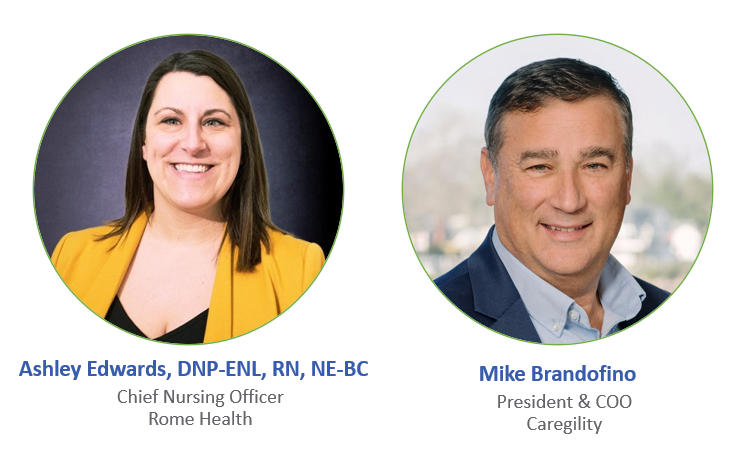
Healthcare isn’t short on patients. It is short on time, staff, and sustainable workflows. In this episode of Digital Health Frontiers, Mike Brandofino speaks with Rome Health‘s Chief Nursing Officer, Ashley Edwards, about how they are rethinking care delivery through a virtual nursing model designed to support bedside teams.
By shifting administrative and non-clinical tasks such as discharges, admissions, and medication reconciliation to virtual workflows, Rome Health is giving clinicians more time with patients and reducing workload pressure. The program is nurse-led and built to extend existing staff, not replace them.
Ashley shares how the team focused on optimizing workflows before introducing technology, enabling a faster launch and smoother expansion into new use cases. By staffing virtual roles with their own clinicians, Rome Health strengthened trust, improved collaboration, and retained experienced nurses in new ways.
The impact is already clear. The organization is seeing meaningful improvements in patient satisfaction along with gains in efficiency and care team experience. By tracking key metrics such as burnout, adoption, and length of stay, Rome Health is building a strong case for the long-term value of virtual nursing.
This episode offers a practical look at how to implement and scale virtual care in a community health system, with lessons on workflow design, change management, and measuring outcomes.
Listen Here:
Read the Transcript
Mike Brandofino Sr
Well, hello, everybody. I’m here with Ashley Edwards, CNO of Rome Health. And we’re here to just talk about her experience and what they’re doing to drive virtual care through their health system. So, Ashley, thank you very much for joining. Maybe you could start off with just a little introduction about you and Rome.
Ashley Edwards
Sure. I’m the Chief Nursing Officer and Vice President of Clinical Services. I’ve been with Rome for about 14 years. This is actually the only place I’ve ever worked. So I started as a graduate nurse here. I also just completed my Doctor of Nursing Practice and Executive Leadership. And that’s kind of where Virtual nursing for me kicked off and how we wanted to implement that.
Mike Brandofino Sr
Great. So, one of the things that I think many of the listeners are familiar with is some of the larger health systems talking about the challenges they face and what programs they’re implementing. And it’s so encouraging to see a health system like Rome embracing technology. Could you just talk about, you know, your path towards that and what are the things that made you convinced that you needed to go down that path.
Ashley Edwards
Yeah, so when I was doing my main project for my doctorate, I was really looking at the post-COVID world as everybody faces the nursing turnover. When I started digging deep into what led into nursing turnover, it was a lot about burnout, which is unsurprising between all healthcare organizations. But when I started really unpacking, it was really the workload. So, we talk a lot about nursing ratios. I don’t love to talk about that because there’s so much more than just that. So, when we start looking at workload, I started thinking, you know, how can we start helping the bedside nurses with their workload, especially in these higher acuity patients that we’re seeing post-COVID?
Mike Brandofino Sr
Sure.
Ashley Edwards
So what I decided to go down the route of was, can we use a virtually integrated care delivery model where the virtual nurse isn’t taking away the bedside tasks, but is taking away the administrative tasks, allowing the nurses to get back to the bedside, back to time with the patients, time with the families, you know, doing what they became a bedside nurse to do? So that’s kind of how we launched virtual nursing.
Very lucky that about the same time I was finishing up my project, we received a grant through the Mother Cabrini Health Foundation. Mother Cabrini also recognized that we needed to kind of shift how we were doing retention in New York State. So they put together a significant amount of funds for organizations and we were very lucky to be chosen for that. A caveat that they also included along with the magnet journey was funds for virtual nursing. So it was, you know, it was almost serendipitous that I was finishing my project and then we were able to receive the grant for the money for that.
Mike Brandofino Sr
Great. And so has your decision been to try to blend your existing staff with virtual and floor-based, or were you looking to outsource nurses?
Ashley Edwards
Yeah, good question. Because we did look at both because there’s, you know, both models definitely exist and they definitely have benefits, pros and cons to both. But as a community hospital, when we looked at it, one of our main principles was that we were going to use our own staff for multiple reasons. We wanted to make sure that there is still communication between the nursing staff and the bedside. There’s a lot of changes, and we wanted to make sure that that was smooth. We wanted to make sure that there was trust between the bedside nurses and virtual nurses. ICU nurse by background, we’ve become very protective of our patients.
Mike Brandofino Sr
Sure.
Ashley Edwards
And you know, you’re a virtual nurse, getting involved in my care. So for it to be – we call it Sarah squared – Sarah and Sarah and Taylor, who are people that they already know, they’ve already got that trust with their care partners, and it allowed this change to be much more smooth.
Mike Brandofino Sr
So interesting, we’ve had some customers say that they actually have been able to extend the careers of some nurses by doing that and thereby keeping incredible knowledge within the health system. And again, that familiarity with those more senior nurses, is that something that you’re thinking of doing or already have seen?
Ashley Edwards
Yeah, so we actually have one nurse who joined us because she’s a really, really strong ICU nurse, has a ton of clinical knowledge, but the bedside just wasn’t for her life right now with what’s going on. And so we were able to transition her into the virtual nurse role. So, great clinician, lots of experience, and we were able to save her as one of our Rome Health family members. So definitely we’ve seen that benefit.
Mike Brandofino Sr
That’s great. We’re actually working with a couple of universities, and one in particular in New Jersey, where they’re developing a certification, accredited certification program for virtual nursing, specifically looking to target nurses that either physically can’t be on the floor anymore, or recently retired, but really still have that passion, as all nurses do for care, to be able to help augment the available resource, because we can never have enough nurses, right?
Ashley Edwards
Yeah, that’s awesome. Because when you look at, we’ll just take New York State, for example, if you look at the number of licensed nurses, that’s not how many are practicing. We nurses, we like to hold on to our licensure even after most of them retire. So you can’t really get a true gauge, but there is still, you know, a big pocket of nurses that if we could optimize this, we could take advantage of. So I think that’s great.
Mike Brandofino Sr
Great. So what workflows are you currently doing and where’s your vision as far as where you’d like to expand?
Ashley Edwards
Yeah. So Sarah and I talk about virtual nursing and our vision a lot, because really you could just keep expanding and expanding and expanding. So we’re trying to figure out where our best, we’ll say bang for our buck is as we do this. So we started with discharges. So we’re doing discharges right now, Monday through Saturday is how our pilot works, 7 a.m. to 7 p.m. So if there’s a discharge during that time, the virtual nurse is doing it. We’re really excited that this week we’ve trained our pharmacy techs on the virtual nursing platform. So they’re starting to do medication reconciliations. And then next week, we are launching admissions. So they’re going to be taking on any of the non-clinical aspects of the admission process. So we started small. We’re already starting to very quickly expand.
Mike Brandofino Sr
Nice. There are literally dozens of workflows that can happen. Interesting, we were at one customer recently and this is the first – I wish I could have recorded it – the first time I heard them say there are too many workflows because there’s some contention for the camera and access to communication with the patient from behavioral health to dietary, you know, there’s so many reasons to try and get into that room, which is great because I think the more we can leverage that, you know, it’s all about, you kind of said this, but you know, we kind of use the phrase, allowing nurses to practice at the top of their license more hours of the day, right? So it’s exciting to see that. You know, as you went through this process, what challenges can you maybe give feedback to people who will be listening to this, what they should look out for as you roll out a program?
Ashley Edwards
Yeah, for sure. For sure. Yeah, I think that the first takeaway – and I have a really, really good rapport with our chief informaticist so we talk a lot about this – but technology is a tool. So it’s only as good as the systems that you already have in place. So what we found that was really successful is we hired our lead, Sarah, early before we even determined that we were going to go with Caregility. And we did a lot of planning. We actually used the Cotter’s 8-step change model so that we could make sure that we were really successful. We set up a sense of urgency, the strategic vision. We worked through all of our barriers. Before we decided to go with discharge planning, we revamped the entire discharge workflow so that we could make sure our workflow was seamless before we added the technology to it. A lot of times, if you’re just throwing technology onto a problem, you’re not going to see the resolution that you’re looking for. You really have to optimize your workflows first and have a plan. So that would be my biggest lesson.
Mike Brandofino Sr
I think that’s really important. I’ve had many conversations with leaders in health systems where we try and encourage them to resolve the process problems first before you apply technology to it, because technology is not going to fix it if it’s already a broken process. So you mentioned that you guys got some funding. What’s that like? And what are the key things that enabled you to win and get that funding?
Ashley Edwards
So we were one of, I believe, 12 organizations throughout New York State that were awarded the Mother Cabrini Health Grant. It’s over five years. So we actually received the max, which is $1 million a year, for five years, so 5 million total. The end goal is to achieve ANCC magnet designation. But then like I said, a sliver of that also was for virtual nursing. So when we received that, it was specifically allotted towards both the technology and the FTEs for nursing. So we put in for a lead and two virtual nurses. That’s where we’re starting. What’s going to be really important, especially as a community hospital, is to make sure that we’re tracking our metrics to know that when that money’s gone, that we’re viable, because we don’t want to look back five years from now and not remember where we came from. So that’s a lot of Sarah’s role, is to help us track all that. No pressure on Sarah.
Mike Brandofino Sr
Yeah, right. So we’ve been talking a lot about nurses, but obviously this technology is available to doctors, physicians as well. Are there programs that you’re implementing leveraging the technology for them as well?
Ashley Edwards
We haven’t yet. We’ve talked a lot about it. We have some specialty consults that are available throughout the entire day. They come at certain points. And could we decrease our length of stay or improve our efficiency if we could get that access to the physician? So it’s definitely on our radar.
Mike Brandofino Sr
Okay. And then are you needing to support any rural areas out, you know, from your facility at all or?
Ashley Edwards
Not yet, nope.
Mike Brandofino Sr
Okay. And that’s another obviously big topic these days. And of course, there’s funding available for rural health as well that the health systems can go after.
Ashley Edwards
No, we haven’t gone down that route yet. We’re really just focused on the discharge and admissions and really seeing what we can do on the floor that it’s on right now.
Mike Brandofino Sr
Great, great. Well, is there anything else you’d like to share or what’s, you know, you mentioned a couple of new workflows that you’re going with. What’s your kind of, you know, target, what you want to achieve with some of this technology as a whole?
Ashley Edwards
Yeah. So we are doing nursing research based on this, which is really cool. So what we’ve started studying is we did a pre and then we’re doing a three-month, six-month and nine-month lookout. And we’re looking at burnout and we’re looking at technology acceptance. So it’ll be interesting to see, as we leverage virtual nursing, how those scores change. We’re also tracking our patient satisfaction and then length of stay. So those are kind of our key metrics that we’re watching. We’ve already seen some really great improvements. I was just sharing with Sarah early this week for our patient satisfaction. It’s really, really quite astonishing. So to be able to continue tracking that.
Mike Brandofino Sr
Great. That is a consistent thing that we’re hearing. And it’s funny because if anyone attended health events five years ago, there was this conversation about depersonalizing care when you introduce remote care. And people were worried that it would negatively impact the experience of the patient, but we’ve actually had the exact opposite. And I think it stems from the feeling that they’re getting more focused attention.
Ashley Edwards
Yeah. For sure.
Mike Brandofino Sr
Maybe the nurse that comes into the room gets pulled out for an alarm and only has 5 minutes or doesn’t get to actually have a conversation with the patient. And we’re seeing that definite improvement in patient satisfaction scores, which is great.
Ashley Edwards
Yeah. Exactly. I think that you hit it on the head. So, our discharge information domain from Press Ganey, on our fourth quarter for discharge domain, was in the 51st percentile nationally. In March, we’re at 98th percentile.
Mike Brandofino Sr
Nice. That’s fantastic.
Ashley Edwards
So, huge, huge achievement, yeah.
Mike Brandofino Sr
It’s great. And, you know, capturing those metrics, I think, really justifies the program. I think a lot of times we intrinsically know there’s value, right? But capturing the metrics is so important because it proves it. And we have seen impacts on length of stay. Obviously, on the patient safety side, we’ve seen huge impacts from fall prevention. And now, you know, as we move into more smart rooms with more sensors, things like radar and incontinence sensors, I think that those scores are just going to get better and better.
Ashley Edwards
Yeah, I agree.
Mike Brandofino Sr
Well, Ashley, thank you very much for joining us today and sharing your story. We really appreciate you selecting Caregility and we look forward to partnering with you and driving your vision and look forward to follow up and maybe seeing you in person soon.
Ashley Edwards
Of course. Thank you.
As I said, I think it’s such a great story because even our focus historically has been in the larger health systems, but it’s so great to hear your story and see you guys be successful. It’s really encouraging.
Ashley Edwards
And I think just kudos to you guys. I mean, we spent a lot of time looking through finding a partner and Caregility has just been exceptional. So we’re really, really thankful for that. The team has been great.
Mike Brandofino Sr
Great, thank you. Fantastic.
Subscribe to Digital Health Frontiers and listen in on your favorite podcast app here.
