


In under a year, Rome Health’s virtual nursing program returned an estimated 718 hours to the bedside, lifted discharge-information scores from the 51st to the 98th percentile, and helped cut nurse turnover. The bigger lesson for rural leaders is how they got there.
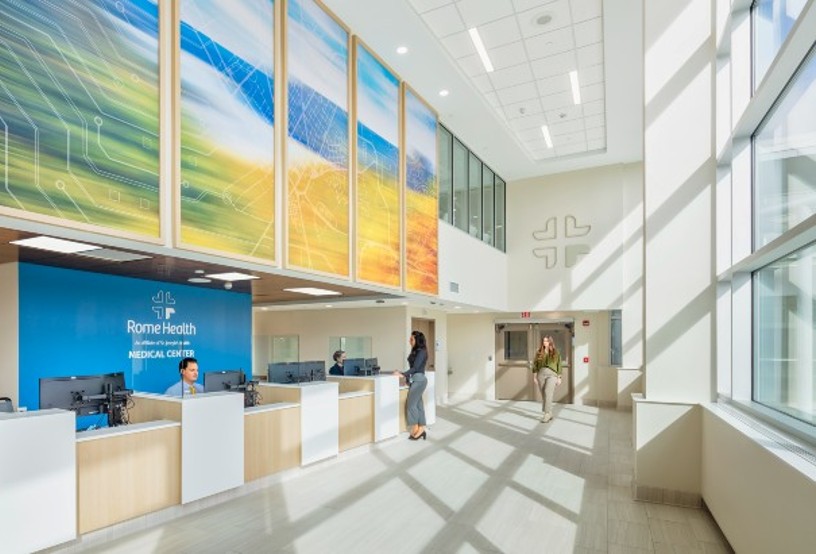
For rural hospitals, supporting an overstretched nursing workforce means finding ways to give nurses more time with patients while preserving the personal relationships that define community care. At Rome Health, an independent, 128-bed community hospital in Central New York, that challenge prompted a new approach to nursing care.
When Ashley Edwards, DNP, RN, NE-BC, became Rome Health’s chief nursing officer and vice president of clinical services in 2023, she inherited a workforce in crisis. “I was handed a lot of turnover and a lot of burnout,” she said.
She found a recurring challenge: administrative tasks pulling nurses away from patients. Discharge education was getting squeezed, and the hospital’s Press Ganey discharge-information score sat at the 51st percentile. With little staffing redundancy to absorb the pressure, Rome Health needed a different way to extend nursing capacity. A Mother Cabrini Health Foundation grant, tied to broader workforce retention and Magnet journey goals, gave the rural community hospital room to build deliberately.
Start with the work nurses need help doing
Edwards began exploring how virtual care could help relieve nurse burden. Through a focused virtual nursing program, Rome Health sought to shift time-intensive work to dedicated nurses who support patients remotely from an onsite hub.
Edwards’ first step was hiring Sarah Dutch, RN, as virtual nursing clinical coordinator. Dutch spent roughly three months examining clinical workflows and identifying what needed to change. That sequence became a guiding principle: fix the workflow first, then add technology.
“If it feels like extra work for the bedside, it’s not going to get adopted,” Dutch explained. “We needed to be ready to add this virtual layer without it feeling like extra work.”
Build trust before asking people to change
The Rome Health team focused first on discharge support on a 38-bed medical-surgical unit, then expanded into admissions as staffing and processes became established.
Bedside nurses had practical concerns: Would virtual nursing create more work? Who would be talking to their patients? How would responsibilities change?
Edwards and Dutch involved frontline nurses in identifying inefficiencies, testing workflows, and defining roles. Hospital-employed nurses staffed the virtual program, preserving familiar relationships within the care team. Importantly, those nurses began helping with discharges in person before the technology was in place. Bedside staff could see the value of the support and build confidence in their colleagues before moving to screen-based encounters.
Leadership also made clear that the program would support existing bedside staffing.
“We weren’t going to change our ratios,” Edwards said. “We were going to make sure we had the right people where we needed them.”
Start narrow, with work that matters
Working from a separate onsite space protected virtual nurses’ time for education, documentation, and coordination that competing demands could interrupt on the floor.
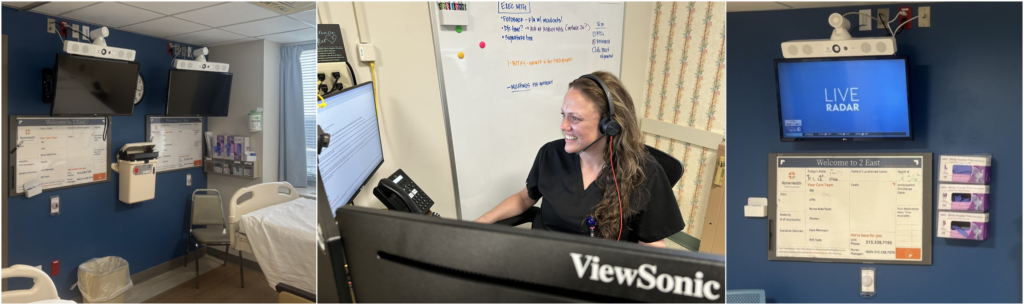
Virtual nurses work from an onsite hub, Monday through Saturday, 7 a.m. to 7 p.m. During discharge, virtual nurses spend dedicated time reviewing medications, explaining symptoms to watch for, involving family members, and checking follow-up arrangements. Bedside nurses remain responsible for hands-on care and coordinate the encounter.
Admissions were added only after the discharge workflow and staffing felt solid.
Camera endpoints mounted in the patient room face the wall when not in use, and a doorbell tone plays when a remote nurse initiates a virtual session. Early on, Dutch introduced herself room by room: “I’m Sarah, I’m your virtual nurse, I’m a real person.” Today, Edwards said, patients ring the call bell and ask for the virtual nurse by name.
Improving capacity, experience, and retention
From February through August 2026, virtual nurses completed 1,437 admission and discharge workflows, covering roughly 80 to 90% of daily discharges. Early results include:
- Capacity returned: an estimated 718.5 bedside RN hours, or about 60 twelve-hour shifts (assuming 30 minutes per workflow).
- Patient experience: discharge information rose from the 51st to the 98th percentile nationally. Communication about medicines climbed 23.49 points, and information about symptoms rose 44.12 points.
- Readmissions: all-cause readmissions fell from 9.43% in Q1 to 6.13% in Q2, a 35% relative reduction. Readmissions are multifactorial, so Rome Health reports this as an associated outcome.
- Throughput: discharge order-to-out time improved by 20.5 minutes.
- Acceptance: nurse technology-acceptance scores improved from baseline and held at six months.
Tracking these measures is central to the program’s future.“This is a grant-funded project,” Edwards explained. “So, I know that in five years, when the grant runs out, I’ll be going to the rest of my exec team saying, this is why it needs to stay.”
Edwards credits the process, not just the screen. Virtual nurses have time to double-check medication reconciliation, confirm follow-up appointments, and call primary care offices. “Those are all things that the bedside nurse doesn’t always have time for,” she said.
The workforce impact is just as striking. Med-surg turnover dropped from nearly 100% to roughly 30% year to date. The new-graduate transition program, which lost about 70% of its nurses the year before, has lost only two. Burnout scores remain high, but Edwards said nurses keep writing the same comment: “I’m still burnt out, but please don’t ever take virtual nursing away from me.”
The program is now growing into a hospital-wide virtual platform, with pharmacy, medical imaging, and nutrition exploring new workflows.
Lessons for rural nurse leaders
Rome Health’s advice for peers is practical:
- Start narrow. Pick one workflow with clear, measurable value.
- Fix the workflow before adding technology. Technology amplifies a good process; it doesn’t fix a broken one.
- Co-design with nurses. “I’ll say that three times,” Dutch said. “Getting your nurse buy-in” is the biggest driver.
- Protect the role. Edwards resists pulling virtual nurses onto the floor: “She’s going to take on so much other stuff that we’re going to lose the value.”
- Measure early and often. Establish baseline measures before go-live. That evidence sustains the program when grant funding ends.
Rome Health’s experience offers a manageable starting point for peers: identify a task that pulls nurses away from patients, improve the workflow with frontline input, and establish clear handoffs before adding technology.
As confidence grows, additional opportunities emerge. Rome Health is expanding admissions support and exploring applications across other disciplines, including pharmacy and nutrition.
For Dutch, the lesson remains rooted in leadership and daily practice: “Technology does not create readiness. Leadership does.”
Want the full story? Watch the NRHA webinar “From 51st to 98th Percentile: How Rome Health’s Virtual Nursing Program Is Transforming Patient Experience” with Ashley Edwards, Sarah Dutch, and Caregility CNO Susan Kristiniak on demand. Explore Caregility to learn how rural hospitals are building virtual programs that last.
